The Need
Artificial intelligence provides a profound opportunity for charitable giving: creating efficiency and improved systems, facilitating better response to global need, and, most importantly, a chance to unlock unprecedented giving to critical causes. Donors, motivated by impact, generosity, and connection to cause, want to make a difference. At the Gates Foundation, recognizing the untapped potential for AI in the field, the Philanthropic Partnerships team designed a hypothesis: AI can reshape the giving landscape by unlocking bold new possibilities to unleash radical generosity that transforms the future of philanthropy. In exploring ways for AI to facilitate that impact, the team sought to engage in creative design thinking with top philanthropic leaders to design an innovation fund to explore: How might AI facilitate wealthy donors to give more, sooner?
In service of their big idea, the Philanthropic Partnerships team partnered with Intentional Futures to design and facilitate an AI Design Day: an immersive, collaborative working session with nonprofit and philanthropic leaders from across the field that would help shape the direction of the AI for Giving Fund and model a more human-centered approach to AI in philanthropy.
What We Did
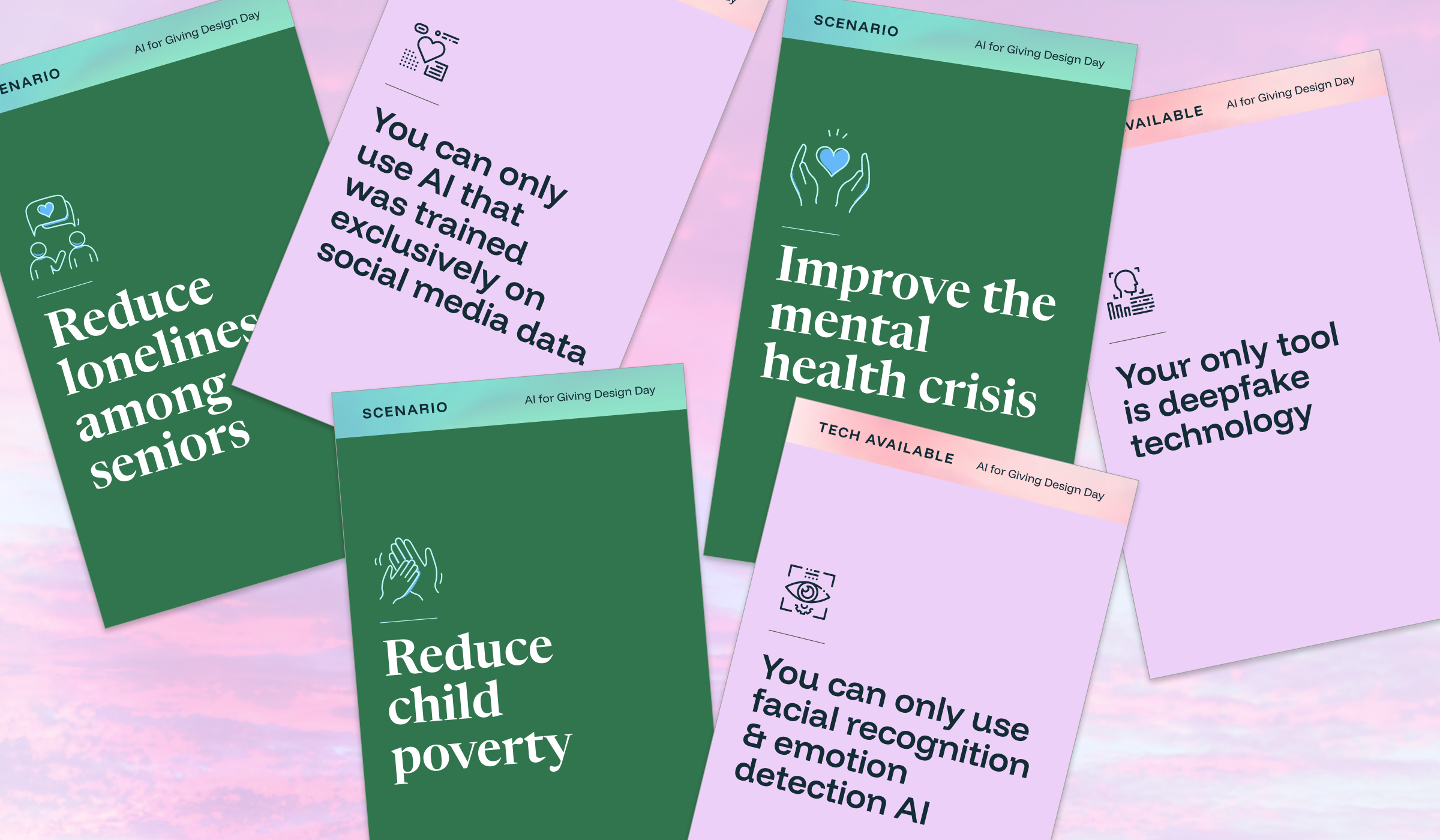
iF designed and facilitated the AI Design Day as a highly interactive, in-person experience that blended imagination, critical reflection, and hands-on concept development. Rather than treating AI as a purely technical problem, the day centered a deeper question:
What kind of philanthropic future do we want AI to enable?
We took their proposed use cases, conducted a landscape and research across the field, and proposed revised use cases, some of which pushed on our assumptions. The day opened by establishing shared norms and grounding participants in why they were together. An opening energizer, The Constraint Game, invited participants to rapidly design solutions under playful limitations, reinforcing the idea that constraints can spark creativity rather than limit it.
To move participants beyond present-day scarcity thinking, iF designed and facilitated an engaging, intentional day of activities to provoke true out-of-the-box thinking, identify opportunities and barriers inherent in the current philanthropic landscape, and do some radical dreaming about what might be possible in a re-envisioned system. Throughout the day, iF curated a series of “Spark Talks” presented by participant leaders to challenge assumptions and introduce new frames, including:
- Why philanthropic data fails to move donors and how AI could enable more emotionally resonant storytelling
- How AI-driven prediction could help philanthropy anticipate and respond to human need earlier
- How trust networks might be made visible at scale, enabling donors to follow trusted advisors with confidence
Each provocation was followed by facilitated discussion to ensure ideas were actively integrated into the group’s thinking. Core to the engagement was exploring, interrogating, and building on the five proposed AI-for-giving challenge areas:
- More Informed, Strategic, & Transparent Giving
- Faster, Better Grantmaking
- Deeper, More Meaningful Relationships
- More Giving to Global Health & Development
- Emotional Resonance & Connection to Cause
Using large-format posters and guided prompts, groups identified main tensions, imagined AI-enabled solutions, and considered ethical and feasibility implications. A rotating “jigsaw” structure allowed ideas to evolve as participants encountered multiple perspectives.
To move from ideation to prioritization, iF designed a “Spark Tank”: a pitch-based funding simulation that mirrored real philanthropic decision-making. Groups developed short pitches and allocated fictional funding based on shared criteria, including impact, feasibility, and cost.
This exercise surfaced clear signals about where collective energy and confidence were strongest, while also revealing the tradeoffs inherent in funding AI-enabled solutions.

Impact
While the AI Design Day produced many ideas, it went even further by generating strategic clarity and shared direction for the AI for Giving Fund.
Key outcomes included:
- Alignment around the need to narrow the fund’s focus rather than dispersing resources too broadly
- Strong momentum toward prioritizing deeper relationships and global health & development as initial challenge areas
- Moving beyond simple donor-matching tools or point solutions to AI infrastructure as an enabling condition
- Recognition that learning, experimentation, and field-building were as valuable as near-term outcomes
- Clear direction toward a hybrid fund model combining cohort-based learning with deeper “proof point” investments
These insights directly informed iF’s subsequent AI for Giving Fund design recommendations, shaping decisions around fund structure, governance, learning objectives, and future-state strategy.
More broadly, AI Design Day modeled a different way of engaging with emerging technology, one that treats AI not as an end in itself, but as a tool in service of trust, human connection, and radical generosity.