
-1.jpg?width=300&name=OER%20global%20market%20Case%20Stud%20(Linkedin)-1.jpg)
Expanding Access to Free Curriculum in Global Education Markets
How can the OER Project expand beyond the U.S., and what will it take to succeed globally?
The OER Project offers free, high-quality curricula in Big History, Climate, and World History built to be engaging, inspiring and targeted for secondary school educators. Its impact lies in expanding access to high quality learning materials while supporting educators with research-based pedagogy and community. By removing cost barriers and emphasizing global perspectives, learners can see connections between time and place and better understand the complex forces shaping today’s world. With strong adoption in the U.S., the OER Project was considering global expansion and engaged our team to investigate: Which international markets might most benefit from OER Project curriculum, and how should we approach them?
“iF’s research-backed insights were essential as we evaluated if—and when—to expand into global markets. They have a unique ability to take complex challenges and translate them into clear, actionable strategies that meet our needs. Coupling deep expertise with creative problem-solving, iF has become an invaluable partner—and it’s why we continue to turn to their team when we’re navigating critical decisions.”
Background
As emerging technologies increasingly level the educational playing field, demand for open-source, digital-first learning content continues to grow around the world. In some global markets, free access to high quality materials can be game-changing. The OER Project’s rigorous and globally relevant curriculum has the potential to meet this demand—but international expansion requires more than great content. It calls for an understanding of market readiness, curriculum alignment, cultural nuance, and local delivery ecosystems.
To help the OER Project navigate this complexity, iF partnered with the team to analyze global opportunities, assess the conditions for success, and identify where and how OER Project could make the greatest impact.
Our Approach
We designed two focused sprints, each crafted to progressively refine understanding and identify actionable strategies for global growth.
Sprint 1: Market Exploration and Hypothesis Generation
The team began by exploring a broad set of English-medium markets across multiple continents. Through this process, we assessed teacher behaviors, local trust ecosystems, and technological realities that shape how educators discover and adopt new tools. From these insights, iF developed early go-to-market hypotheses, emphasizing the importance of adapting to on-the-ground realities—such as using messaging apps in low-tech settings or partnering with centralized educational repositories.
Sprint 2: Market Validation and Prioritization
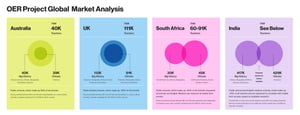
Building on the initial exploration, the iF team then narrowed our focus to a set of high-potential markets. We conducted deeper research into educator population sizes, curriculum compatibility, and potential barriers to entry. Insights from this phase were synthesized into a decision-support tool that enabled the OER Project team to compare markets side-by-side, plan and prioritize.
What We Found
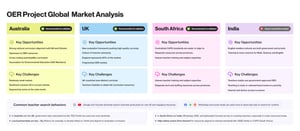
Each market revealed its own combination of opportunities and challenges. In some, strong curriculum alignment and cultural openness to OER Project products coincided with well-established digital infrastructure and a high degree of teacher autonomy. Others represented deeply mission-aligned opportunities, like markets where educators and students could most benefit from OER Project’s accessibility and quality, yet where digital access and training varied widely. Still others offered immense scale through English-medium schooling systems but demanded tailored approaches to navigate complex, exam-driven education structures.
Across all contexts, iF found that successful entry would depend on emphasizing local relevance, lightweight content formats, and the cultivation of trust,often by leveraging existing educator networks and platforms.
Deliverables
iF delivered a wide set of strategic tools and insights to set OER Project up for informed, efficient expansion planning:
- A Global Leverage Points Synthesis: Framed strategic plays for content dissemination and partnerships based on country-specific teacher behaviors and systems.
- An Opportunity Sizing of the Total Addressable Market and Readiness Placemat: Visual tool comparing the relative opportunity, curriculum fit, and infrastructure strength across four priority markets.
- Recommendations for how to adapt OER Project’s content formats, build local trust, and sequence engagement over time.
Impact
iF’s work gave OER Project a clear, research-backed framework for global strategy. It answered not just where the OER Project could go next, but also how to get there—efficiently, credibly, and in partnership with the educators it aims to serve.
As global expansion efforts continue, these insights will serve as a springboard for thoughtful investment and action.