


Imagine that a VP of Product posts a mid-level engineering role and gets 200 applications. Three months later, it's still open. The pool is either overqualified or under-experienced because the entry-level roles that would have created the right candidates haven't existed since 2022. A COO of a physical therapy network spends half her week on recruiting and the other half apologizing for wait times. Across sectors, neither have paused long enough to ask what most organizations never get around to exploring: Is our approach to talent development connected to where this organization is actually going? And are we looking for talent in the places that still produce it, or only the ones that used to?
What passes for a talent strategy is too often a hiring process that begins when a role opens and goes quiet when it’s filled. In tech, the process lately has been driven by AI-driven decisions made faster than the organization could absorb. And in healthcare, leadership has been trying to outrun chronic understaffing for years. In both cases, workforce decisions are made reactively, one role at a time, disconnected from business direction. The consequences of those decisions often surface later, when roles can’t be filled and the pipeline feeding them no longer exists.
"What passes for a talent strategy is too often a hiring process that begins when a role opens and goes quiet when it’s filled."
SignalFire's analysis of major tech firms and maturing startups found a 50% decline in entry-level hiring between 2019 and 2024, consistent across functions. The entry-level roles that feed mid-level hiring simply are not there anymore, leaving gaps that show up months or years later.
At the same time, many organizations are making aggressive bets on AI without fully accounting for the capabilities these systems are dependent on. It’s been widely reported that Klarna routed most customer service interactions through AI in an effort to replace those roles. Within a year, quality dropped, complaints rose, and the CEO had to rebalance AI with humans. And Starbucks recently announced terminating its North America AI Inventory tool due to errors, reverting back to manual counting for better reliability.
The result is a combination of challenges. Workers and employers have different ideas about what skills are actually needed. As workers graduate with hard-earned bachelor's degrees, employers are asking for workforce-ready AI skills: a gap that reflects both how quickly the landscape is shifting and how slowly hiring requirements get rethought from the inside. At the same time, years of slow hiring and declining enrollment in higher education have hollowed out entry-level pipelines. The roles that once fed mid-level hiring are no longer there, and as HR analyst Josh Bersin notes, many HR leaders are now scrambling to rebuild early-career development programs.
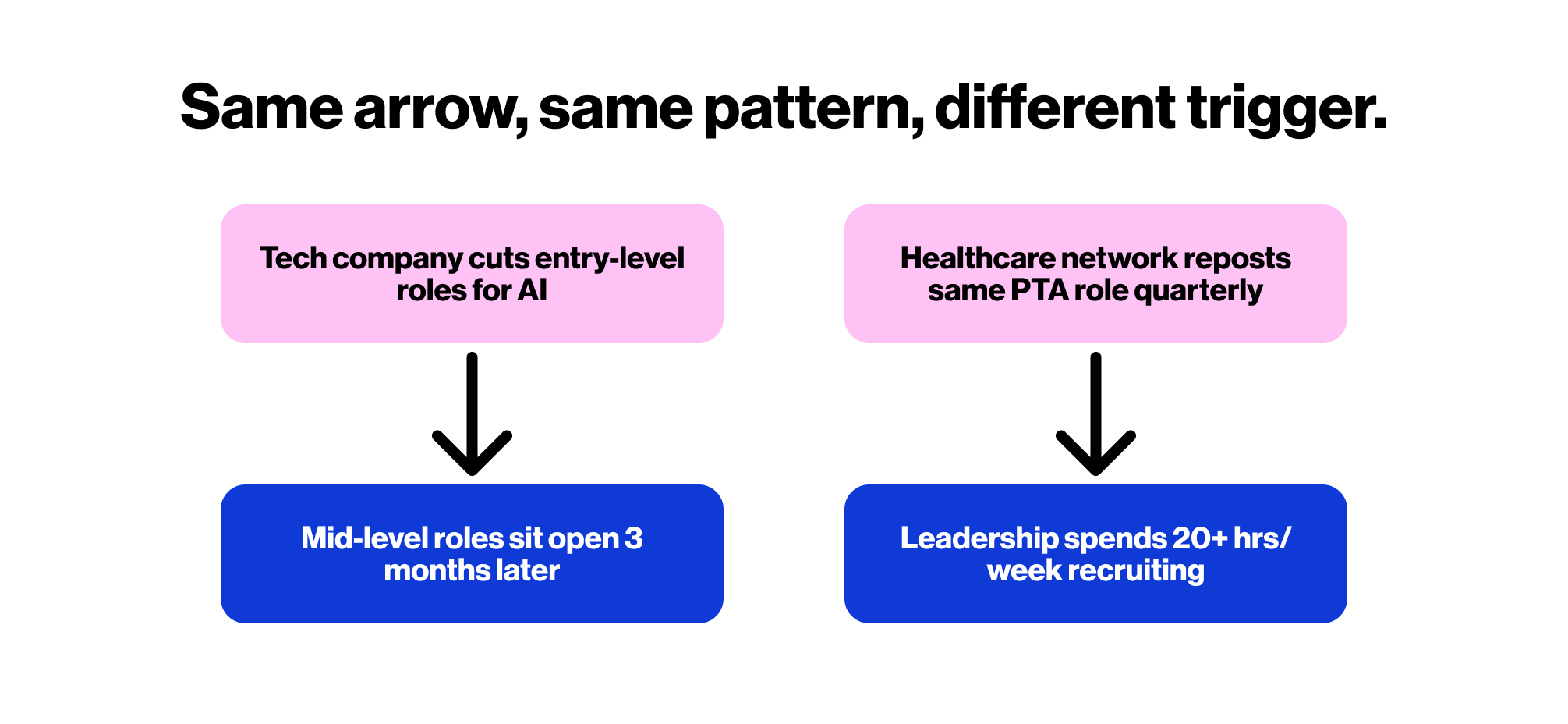
Challenges in hiring and staffing have always existed, but AI is exacerbating a system already undergoing rapid change. Walk into a mid-market healthcare organization in the Puget Sound region, and the same structural problem is already there, just with a different trigger. A therapy network reposts the same PTA role every quarter. A home healthcare agency pays two to three times the market rate for traveling staff because no one has the bandwidth to ask why permanent roles aren't filling. Leadership in these healthcare organizations is buried in recruiting because the system is built around urgent hiring, leaving no space to step back and build a strategic approach while also serving patients. The decisions are not bad. They are often the only decisions these leaders have bandwidth to make.
"The decisions are not bad. They are the only decisions these leaders have bandwidth to make."
Adding more recruiters or switching to a new application tracking system will not fix a problem that lives upstream of the job posting. What’s needed is someone who can connect workforce decisions to business direction. That means asking harder questions:
- Which roles are strategic and which are symptomatic?
- Are pipelines broken, or were they never built in the first place?
If the pipelines that used to feed these roles are gone (or never existed), rebuilding them means more than restoring what broke: it means widening where they start, toward capable people the current system can't see.
At Intentional Futures, we know that most organizations don't have the capacity to step back far enough to see their workforce systems clearly, and even fewer have sight lines across industries. We bring together the people making hiring decisions and the people living with them, and help them surface where perception and reality have diverged. Is AI actually creating efficiency, or is it generating rework no one is measuring? Are the candidates being screened out carrying exactly the skills the role needs, just not on paper? We use this type of diagnostic work–identifying where hiring and skilling is really breaking down–to get creative about solutions: new policies, redesigned roles, or role descriptions that better reflect what the work actually requires. And we bring a perspective that most workforce consultants don't: a deep understanding of nontraditional learners and the pathways that connect them to employer needs that conventional pipelines no longer fill.
If these workforce challenges sound familiar and our approach excites you, we want to hear from you: What is your organization seeing and experiencing, and how can we support it? What resonates about what we’re observing, or what did we miss?