

“Intentional Futures has been a valued partner in helping Seattle Public Utilities take meaningful steps on our continuous improvement journey. They have worked with us on our continuous improvement strategic plan, engaged with us through learning sessions, leadership forums, and executive retreats, and mentored and coached numerous staff in our organization. We are excited to continue our partnership with iF in this growth and maturation process for our organization.” –Andrew Lee, General Manager & CEO, Seattle Public Utilities
The Need
Seattle Public Utilities (SPU) operates at the intersection of some of the region's most pressing challenges. As environmental conditions evolve, infrastructure ages, workforce dynamics shift, and customer expectations grow, the utilities of a city of almost 800,000 must continually adapt while delivering the services residents depend on every single day.
SPU recognized that meeting these challenges would require more than new processes or isolated improvement projects. It would require building an organization capable of learning, adapting, and improving continuously.
For years, employees across SPU had been finding ways to improve their work, solving problems locally and creating meaningful solutions within their teams. While these efforts demonstrated a strong foundation for innovation, they often occurred independently, making it difficult to scale successes, sustain improvements, and align change efforts across the organization.
Leadership needed to build on this momentum and create a shared culture of continuous improvement, one where employees at every level would be empowered to identify opportunities, solve problems collaboratively, and improve how the utility serves both ratepayers and the broader community.
In order to achieve this, SPU needed a clear strategy for organizational change, a roadmap for implementation, and a practical framework for measuring progress over time.
What We Did
Intentional Futures partnered with SPU to help define what a culture of continuous improvement could look like at scale and develop a path to achieve it.
We started simply: by listening. Through stakeholder interviews, leadership workshops, process observations, program reviews, and analysis of existing improvement efforts, we worked to understand how improvement was already happening across the utility and where barriers to broader adoption existed. This in-depth, active research was critical to building trust with the team and ensuring a high level of confidence in the recommendations.
Our assessment revealed a workforce eager to improve the way work gets done lacking a shared operating model to connect improvement efforts across teams. While successful areas existed throughout the organization, leadership needed a common vision, shared language, and clearer expectations to support long-term cultural change.
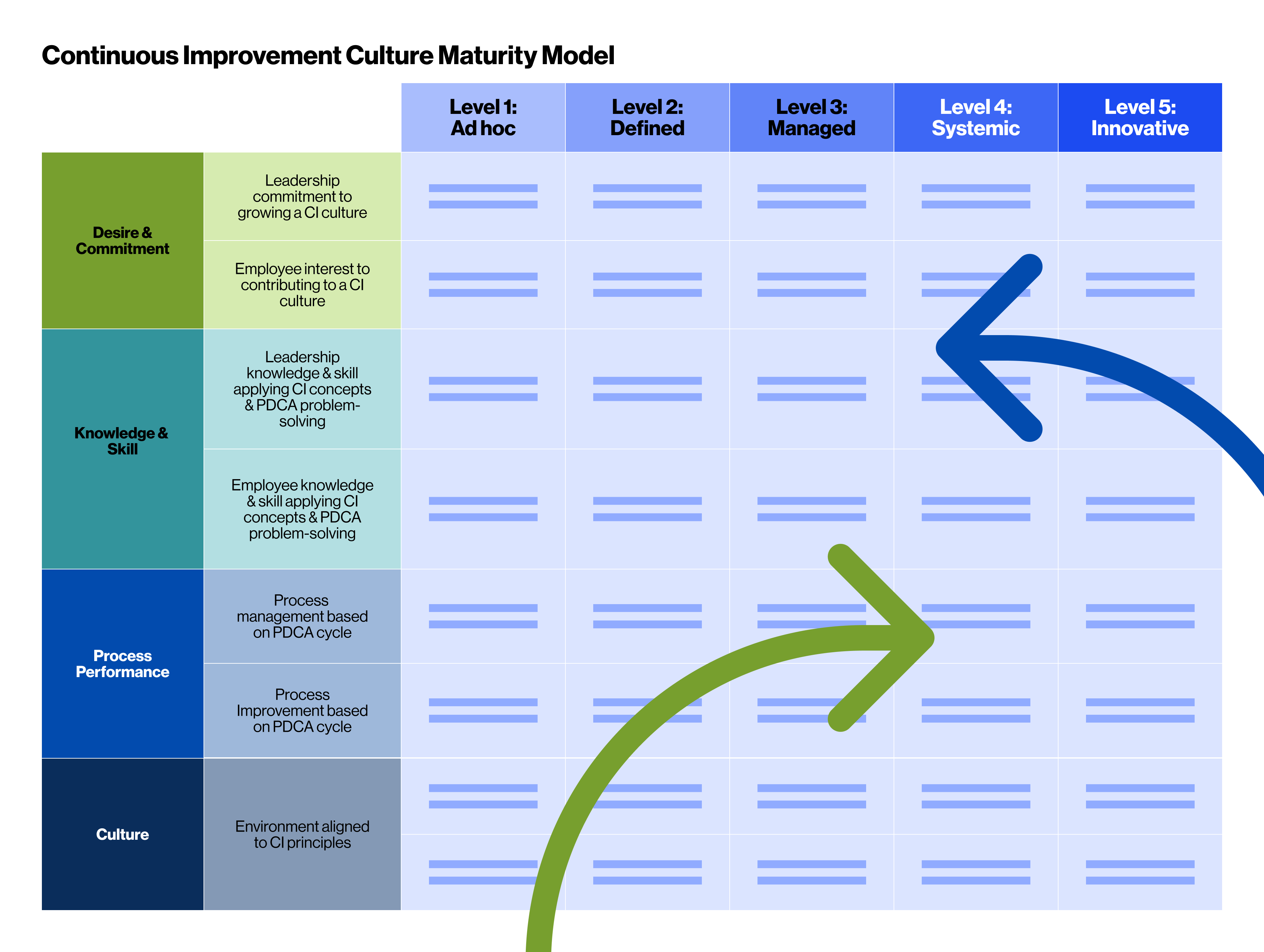
To help create that shared vision, we developed a Continuous Improvement Culture Maturity Model that mapped the journey from isolated, reactive improvement efforts to a fully integrated culture where learning, experimentation, and problem-solving are embedded into everyday work. The framework provided leaders with practical ways to understand SPU's current state, identify capability gaps, and align around a common future.
With that foundation in place, we partnered with executive sponsors and organizational leaders to create a five-year transformation strategy. The strategy focused on strengthening leadership capability, building employee skills, improving operational systems, and creating the cultural conditions necessary for continuous improvement to thrive.
The resulting roadmap outlined how SPU could progressively build its improvement capabilities through leadership development programs, employee-based improvement opportunities, and team-based problem-solving. Rather than treating continuous improvement as a separate initiative, the strategy positioned it as a new way of working, grounded in employee empowerment and service to the community.
To support long-term adoption, iF continues to play a key role with the initiative. We partner with leadership to define key behaviors and practices that reinforce lean principles. iF helps build organizational capabilities by facilitating and embedding development programs such as Toyota Kata. Additionally, we support structural changes to enable continuous learning and improved service delivery by leading teams through a Lean operating model assessment and kaizen workshops.
Impact
The Continuous Improvement Strategy gives SPU a shared blueprint for becoming a more adaptive, resilient, and learning-oriented organization.
Rather than focusing solely on process optimization, the strategy helps position continuous improvement as a core organizational capability that connects leadership behaviors, employee development, operational performance, and organizational culture.
Today, SPU has a clear framework for understanding its current level of maturity, a roadmap for advancing its capabilities over time, and a common vision that aligns leaders and employees around a shared approach to improvement.
The work also created the foundation for broader organizational transformation. By investing in leadership development, employee problem-solving skills, and systems that support continuous learning, SPU is strengthening its ability to respond to change, improve services, and create greater value for the communities it serves.
Most importantly, the strategy recognizes that lasting change does not come from tools alone. It comes from creating an environment where people are empowered to learn, improve, and contribute every day.